Weather's Subtle Influence on Layered Wagers: Adjusting Form Data from Tracks, Pitches, and Courts to Refine Stake Allocation
Elena Koch · May 27, 2026

Weather's Subtle Influence on Layered Wagers: Adjusting Form Data from Tracks, Pitches, and Courts to Refine Stake Allocation
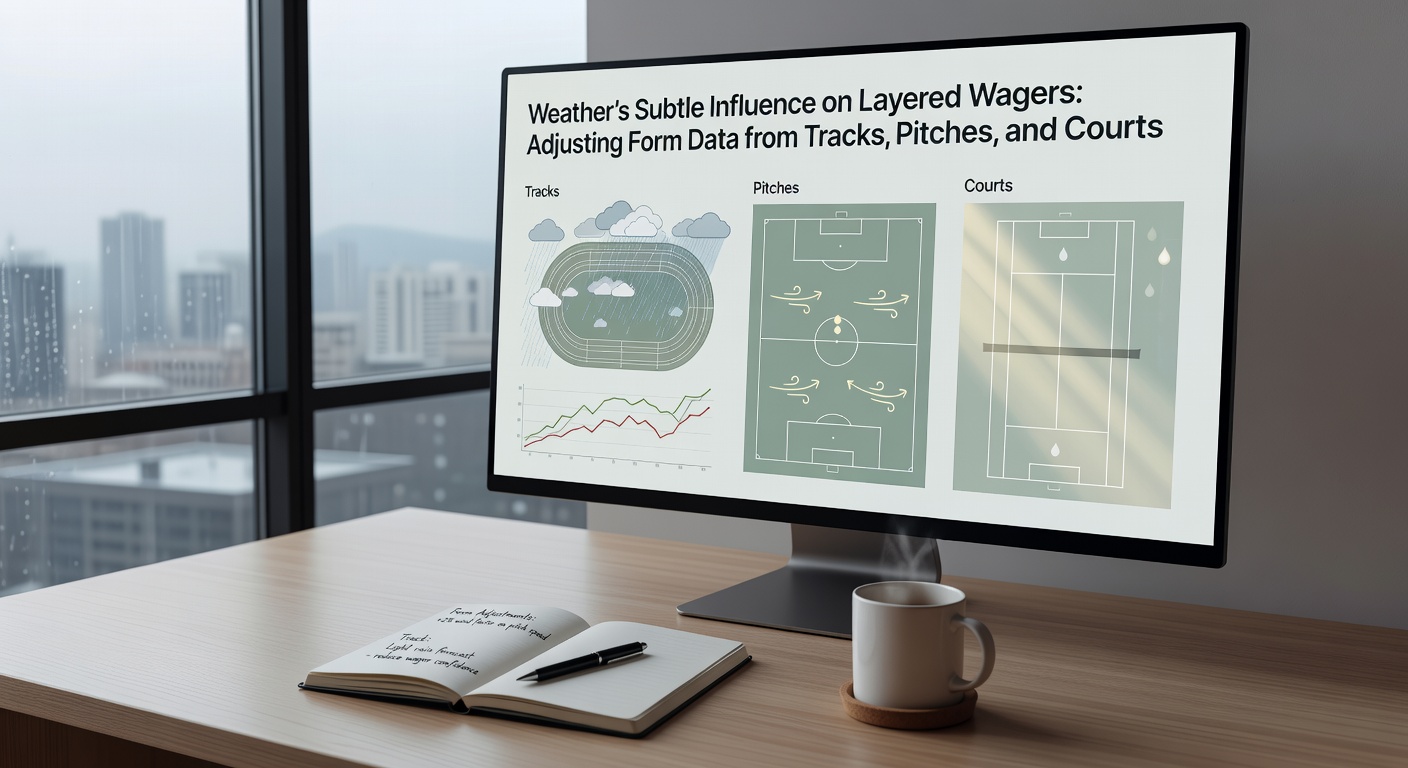
Weather patterns shape performance metrics across equine racing, football matches, and tennis competitions in ways that require careful recalibration of historical datasets before wager sizing occurs. Surface moisture levels, temperature fluctuations, and wind velocities alter speed ratings, possession statistics, and rally durations, which in turn modify the perceived value within multi-leg betting structures. Observers note that professionals who incorporate localized meteorological adjustments often see their stake distributions shift in response to updated probability models rather than static form guides.
Track Conditions in Equine Racing and Moisture Variables
Horse racing surfaces respond directly to precipitation and humidity readings recorded in the hours before post time, with official going reports reflecting these changes through descriptors such as firm, good, soft, or heavy. Data from Australian racing authorities shows that times recorded on rain-affected tracks slow by an average of 3.2 seconds per furlong compared with dry benchmarks, while trainers adjust declared runners based on these forecasts. Bettors who layer such races into accumulators therefore recalculate expected margins by cross-referencing rainfall totals against past performances of each horse on similar surfaces, which produces revised odds thresholds before final stake amounts are set.
Wind direction further complicates straight-course and bend calculations, especially at venues where prevailing gusts align with or against the home straight. Records maintained by the Bureau of Meteorology in Australia indicate that sustained winds above 25 kilometers per hour correlate with measurable changes in sectional times, prompting analysts to apply directional modifiers to raw speed figures before incorporating them into layered wager evaluations.
Pitch Dynamics in Association Football Under Variable Weather
Football pitches experience altered ball roll and player traction when rainfall exceeds 5 millimeters in the preceding 24-hour period, according to studies conducted by the European Club Association's technical working groups. Groundstaff measurements reveal that passing accuracy declines by approximately 7 percent on saturated surfaces while long-ball frequency rises, which directly affects expected goal outputs derived from earlier dry-weather matches. Those constructing accumulator selections that combine football legs with other sports therefore adjust team totals and handicap lines using these surface-specific coefficients rather than relying solely on seasonal averages.
Temperature ranges also influence substitution patterns and injury substitution rates during matches played in extremes, with data compiled by the German Football League showing elevated cramp incidents above 28 degrees Celsius that shorten effective playing time. Analysts integrate these variables into pre-match models so that stake allocations across multi-sport parlays reflect realistic scoring ceilings under the forecasted conditions.
Court Surfaces and Atmospheric Effects in Tennis
Tennis court types interact differently with humidity and temperature, producing distinct bounce and speed profiles that historical point-win percentages fail to capture without adjustment. Hard courts lose pace when ambient temperatures drop below 15 degrees Celsius, while clay courts retain moisture longer after rainfall and slow medium-paced rallies, according to performance datasets released by the International Tennis Federation. Players who compete on grass experience the sharpest changes under high humidity, where the ball skids less and favors baseline exchanges over serve-dominated points.
Wind speeds above 15 kilometers per hour have been shown in peer-reviewed sports science papers from the University of Queensland to increase unforced error rates by up to 12 percent on outdoor courts, prompting oddsmakers and bettors alike to modify over-under totals and player prop expectations before finalizing layered stake distributions. Those who maintain separate databases for each surface-weather combination therefore generate more precise allocation percentages across tennis-inclusive accumulators.
Integration Methods for Multi-Sport Stake Refinement
Professionals combine meteorological inputs with form databases through weighted algorithms that apply correction factors derived from historical weather-performance pairings. A single layered wager containing one equine race, one football match, and one tennis encounter requires sequential adjustment of each leg's implied probability, with the resulting combined odds then compared against available bookmaker lines to determine optimal unit sizing. Research published by the Canadian Sport Institute demonstrates that models incorporating real-time weather feeds reduce variance in projected returns compared with unadjusted baselines.
Regulatory updates scheduled for May 2026 in several jurisdictions are expected to standardize disclosure requirements around environmental data sources used by betting operators, which may further encourage transparency in how weather adjustments influence displayed odds. Operators in North American and European markets have already begun publishing surface condition indices alongside traditional statistics, allowing participants to apply consistent modifiers across their own accumulator constructions.
Conclusion
Weather data integration into form analysis provides a measurable pathway for refining stake allocation across layered wagers that span tracks, pitches, and courts. Organizations such as the Australian Bureau of Meteorology and the International Tennis Federation supply the granular inputs that enable these recalibrations, while academic studies continue to quantify the magnitude of performance shifts under varying conditions. Bettors who maintain updated correction tables for each sport-surface-weather combination position themselves to apply consistent methodology when sizing positions within multi-leg structures.