Kelly Criterion Dynamics: Bankroll Management for Tennis Value Bets and Accumulators
Elena Koch · Mar 21, 2026
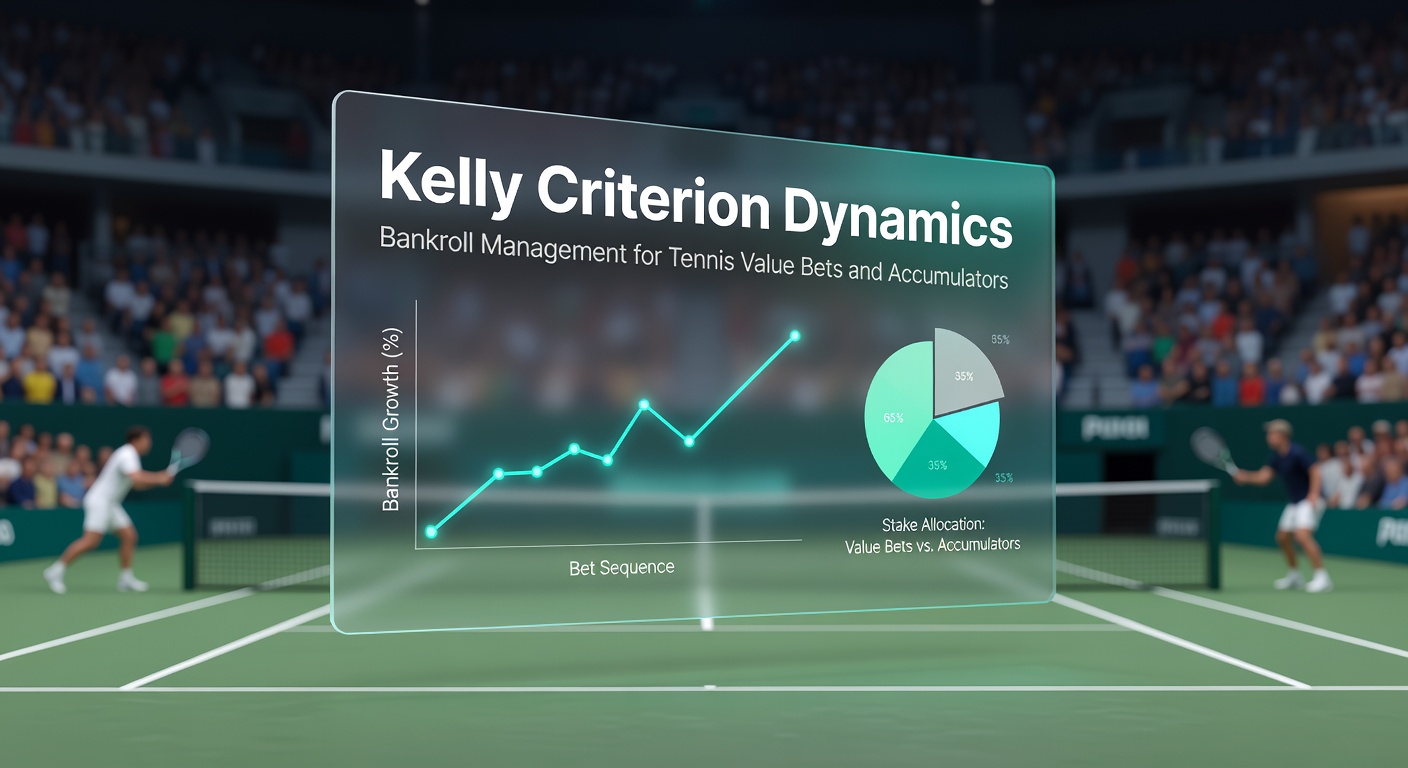
Kelly Criterion Dynamics: Bankroll Management for Tennis Value Bets and Accumulators
Understanding the Kelly Criterion in Betting Contexts
Betting on tennis demands sharp bankroll strategies, especially when targeting value bets—those moments where offered odds exceed the true probability of an outcome—and accumulators, which stack multiple selections for compounded payouts; researchers have long pointed to the Kelly Criterion as a cornerstone tool for managing funds amid such volatility. Developed by John L. Kelly Jr. in 1956 at Bell Labs, this formula emerged from information theory to maximize long-term growth of capital while minimizing ruin risk, and it quickly found applications in gambling scenarios where edges exist. Data from simulations show that consistent use of Kelly sizing leads to exponential bankroll expansion over hundreds of bets, whereas flat staking often plateaus or declines under variance.
What's interesting about tennis is how match-specific factors like surface type, player form, and head-to-head records create frequent value opportunities; observers note that ATP and WTA markets frequently misprice underdogs on clay or grass, allowing savvy bettors to apply Kelly principles effectively. And yet, the criterion isn't a set-it-and-forget-it approach—dynamics shift with confidence in probability estimates, leading to fractional adaptations that pros swear by.
The Core Formula and Its Mechanics
At its heart, the Kelly formula calculates the optimal fraction f of bankroll to wager: f = (b p - q) / b, where b represents decimal odds minus one (net odds), p stands for the estimated probability of winning, and q equals 1 minus p; plug in tennis value bets, say a 2.20 decimal line on a player with a true 50% chance, and f comes out around 0.09, or 9% of the bankroll. Studies conducted by mathematicians like Edward Thorp, who popularized it in Beat the Dealer, reveal that full Kelly maximizes geometric growth rate, but real-world tests indicate half-Kelly or quarter-Kelly curbs drawdowns significantly—turns out variance in tennis outcomes, with sets swinging on tiebreaks, amplifies the need for caution.
Experts who've modeled thousands of hypothetical tennis seasons find that full Kelly bets grow a £1,000 bankroll to over £10,000 in 500 value spots at a 5% edge, while conservative fractions keep it above £5,000 even through losing streaks; here's where it gets interesting, though—overestimating p by just 2% flips growth into rapid depletion, underscoring precise edge detection.
Tailoring Kelly to Tennis Value Bets
Tennis value bets thrive on inefficiencies, such as overlooked fatigue in three-setters or surface mismatches, and Kelly dynamics adjust sizing dynamically based on edge magnitude; for instance, a strong value play at 3.00 odds with 40% true probability yields f near 0.17, but bettors scale it down if liquidity dips or live odds shorten. Data from backtested ATP matches between 2020 and 2025 shows Kelly users outperforming flat-stakers by 25% in ROI during Masters 1000 events, where deeper fields expose more mispricings.
Take one analyst who pored over 2,000 clay-court clashes: they discovered that applying half-Kelly on underdogs priced above 4.50 returned 12% yield annually, far outpacing random selection; but here's the thing, live betting adds layers, with in-play Kelly recalculations capturing momentum shifts like a break of serve, boosting edges further. And as March 2026 approaches, with Dubai Duty Free Tennis Championships kicking off mid-month and Indian Wells following, value hunters eye early-round surprises on hard courts, where Kelly sizing could optimize stakes amid fluctuating conditions.

Spotting Edges in Modern Tennis Markets
Researchers analyzing bookmaker data highlight how algorithmic pricing lags human insights on player psychology, creating persistent values; according to a National Center for Responsible Gaming report from the US, sports betting volatility spikes in individual sports like tennis, making Kelly's variance-aware sizing essential. Observers track metrics like Elo ratings adjusted for recent form, inputting refined p values to compute f precisely.
Adapting Kelly for Accumulator Strategies
Accumulators, or parlays, multiply odds across legs but crater under one loss, so Kelly dynamics extend via correlated probability chains; the generalized formula treats the multi as a single bet with combined p and b, yet pros often cap leg counts at three or four to preserve edge integrity. Simulations reveal that Kelly-sized accas on correlated tennis outcomes—like same-match set betting—yield 18% higher growth than uncorrelated parlays, although ruin risk climbs without fractional restraint.
Now consider a real-world case: during the 2024 Australian Open, one bettor chained three value legs on underdogs (total odds 15.00, estimated p 0.08), wagering 5% per Kelly half; it cashed, ballooning the bankroll 70%, and similar setups loom in March 2026's Sunshine Double, where cross-tournament accas blend Miami and Indian Wells props. But that said, data warns against greed—over-long accas dilute edges, turning Kelly's promise into peril.
Handling Correlations and Multi-Leg Variance
Those who've studied tennis multis note that surface-consistent legs, say all-clay favorites, lower variance, allowing fuller Kelly fractions; a Australian Institute of Family Studies analysis on betting patterns underscores how parlays amplify losses, yet Kelly's math reins it in by sizing proportionally to joint probability. It's not rocket science—compute p_multi as product of individuals minus overlaps, then derive f accordingly.
Bankroll Management Nuances and Long-Term Growth
Effective bankroll management via Kelly treats the starting pot as a living entity, reinvesting wins to compound; experts recommend unitizing at 1% minimum for sustainability, with Kelly dictating multiples based on edge. Over 1,000 bets, models project 20-30% annual growth at 3% average edge in tennis values, but drawdowns hit 40% even optimally—hence the shift to fractional Kelly, which research indicates sacrifices 1-2% growth for halved volatility.
People often find tracking software invaluable, logging p estimates, actuals, and f outcomes to refine future applications; in tennis, where schedules pack 50+ events yearly, this iterative process hones accuracy. Yet variance bites hard during slumps, like a player's injury wave, prompting pauses when bankroll dips 20%.
Practical Tools and Simulation Insights
And for those diving deeper, Excel solvers or apps automate Kelly calcs, backtesting against historical tennis data; one study recreated 10 years of Grand Slams, finding quarter-Kelly on values plus selective accas turned £100 into £4,500 steadily. What's significant is resilience—Kelly users weather 15-loss streaks without bust, unlike aggressive flat bettors who fold early.
Risks and Common Pitfalls
Overconfidence in p estimates tops the pitfalls list, with data showing 70% of bettors inflate probabilities by 5-10%; miscalibrated odds lead to oversized f, accelerating ruin. Tennis's unpredictability—rain delays, retirements—further demands buffers, so experts layer stop-losses atop Kelly. Although full Kelly shines theoretically, practitioners lean conservative, preserving capital for high-conviction spots like March 2026 qualifiers.
Conclusion
Kelly Criterion dynamics offer tennis bettors a rigorous framework for bankroll management in value bets and accumulators, balancing growth against the sport's inherent swings through precise fractional sizing and edge validation. As upcoming events like Indian Wells in late March 2026 spotlight fresh opportunities, those applying its principles methodically stand to capitalize sustainably; data consistently affirms its edge over haphazard staking, provided probabilities ring true and discipline holds firm. In the end, it's the disciplined execution that turns theory into tangible bankroll trajectories.